
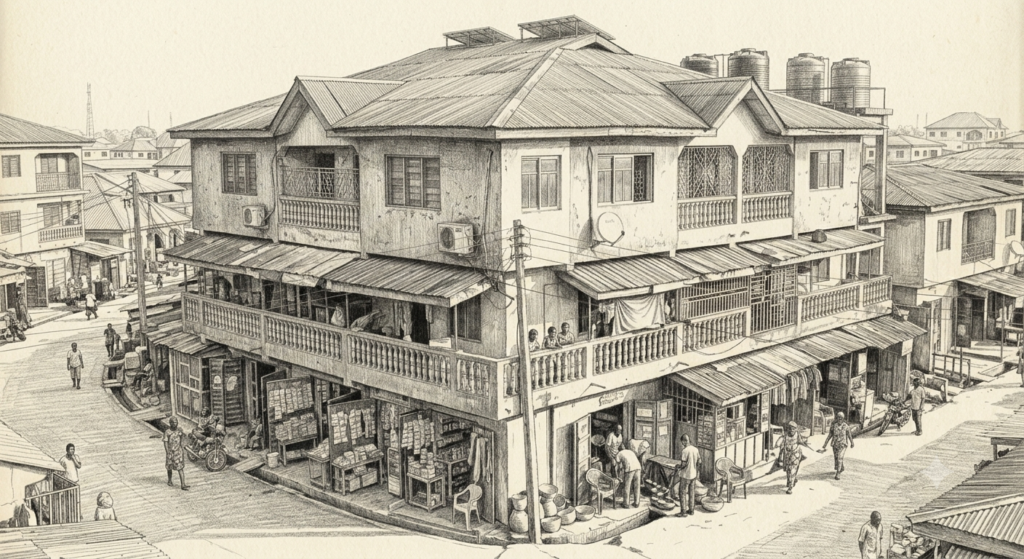
When does architecture stop being traditional and become modern?
Perhaps the better question is: Does it ever?
Somewhere between those two ideas lies vernacular architecture—not as a relic of the past, but as evidence that societies have always adapted. It is where culture, climate, technology, and everyday life converge to shape the built environment. Rather than replacing tradition, new ideas are negotiated, absorbed, and reinterpreted to create something both familiar and new.
This essay explores that process through the vernacular architecture of Ile-Ife. Using selected Nigerian-Brazilian houses on Ojoyin Street as case studies, it examines how Yoruba domestic traditions engaged with imported materials, construction techniques, and spatial ideas to produce architectural forms that were neither entirely indigenous nor wholly foreign.
Although grounded in architectural history, the questions explored here extend far beyond buildings. They invite us to think about how knowledge evolves, how cultures respond to change, and how innovation often emerges through adaptation rather than replacement.
I’m pleased to publish this as the first essay in my Writing Series—a collection of reflections on architecture, cities, culture, and the built environment as living systems of knowledge.
I hope you enjoy reading it, and I’d love to hear your thoughts.
(Kindly login to access full document).
Click to access full document