
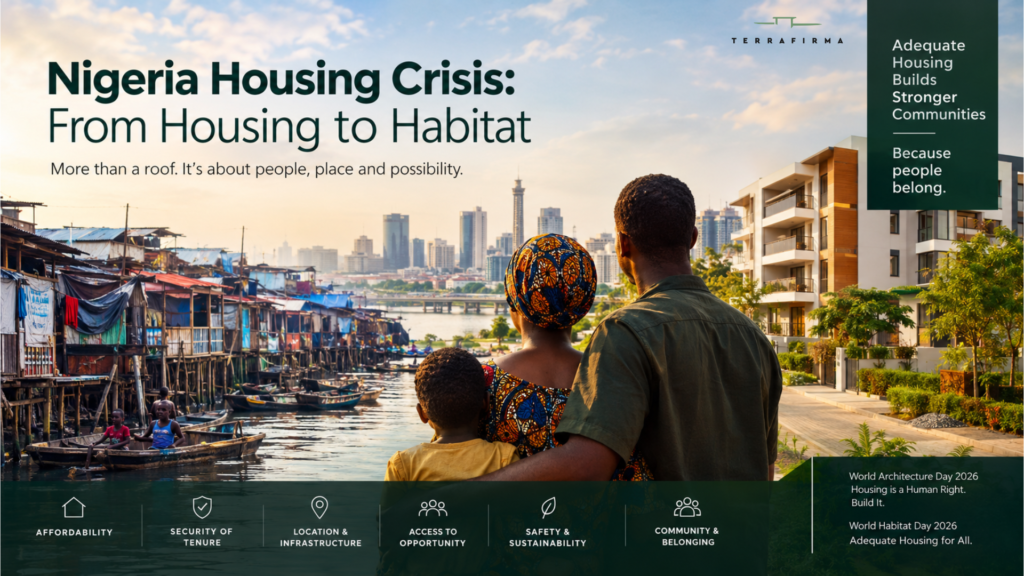
By Arcladytect for TerraFirma Designs Limited
Nigeria’s housing crisis is usually introduced through a number: Millions of housing units.
For years, estimates of Nigeria’s housing deficit have circulated between figures such as 17 million and 28 million units. In January 2026, the Federal Government’s National Housing Data Technical Committee presented a new estimate of 14.925 million housing units for 2025. Federal Government — 2025 Housing Data
The number is significant. It is also incomplete.
Nigeria’s housing crisis is not one problem. It is a set of connected problems involving supply, affordability, quality, tenure, location, infrastructure, access, discrimination, displacement and belonging.
A family can have a roof and still live in inadequate housing.
A household can receive a replacement house and lose its livelihood, social network or connection to the place where it has lived for generations.
A displaced person can receive emergency shelter without having a durable home.
A settlement can be cleared while the people who lived there lose access to schools, markets, work and community.
And a person can have the money to pay rent and still be denied a home because a landlord or agent has decided that someone of their tribe, religion, gender, marital status or occupation is not welcome.
These are all housing questions. This is where the distinction between housing and habitat becomes useful.
A house is a physical structure.
Housing is the wider system through which people obtain shelter: land, tenure, finance, affordability, infrastructure, services and access.
Habitat is broader still. It is the physical, social, economic and environmental context within which people live, work, move, raise families and participate in community life.
And there is another dimension that deserves more serious attention: belonging.
Belonging is not presented here as a new statistical indicator or as another way of calculating Nigeria’s housing deficit. It is an analytical lens for examining what happens when people are displaced, priced out, excluded from rental opportunities or placed in housing that does not fit the lives they actually live.
That distinction is particularly relevant on 5 October 2026, when World Architecture Day and World Habitat Day will focus global attention on housing.
The International Union of Architects has chosen “Housing is a Human Right. Build It.” as the theme for World Architecture Day 2026. UIA — World Architecture Day 2026
UN-Habitat’s World Habitat Day 2026 theme is “Adequate Housing for All.” UN-Habitat — World Habitat Day 2026
For Nigeria, the themes provide an opportunity to ask a more complete question:
What exactly are we trying to provide when we say we are providing housing?
Nigeria’s Housing Deficit: The Number Depends on What We Count
Nigeria does not have one housing-deficit number that can answer every housing question. Different estimates measure different things.
The National Population Commission reported in 2023 that published estimates of Nigeria’s housing deficit had ranged from 17 million to 28 million units, while the Commission and the Federal Government were working towards more credible and verifiable housing data.
The newer Federal Government estimate puts the 2025 housing deficit at 14.925 million units. Federal Government — 14.925 Million Housing-Unit Deficit
The World Bank’s Nigeria: Multi-Sector Analytical Review and Pathway to Transformation gives another useful picture: approximately 87 million people live in poor housing, while the housing deficit is estimated at 17 million units. The report also notes that the deficit is particularly severe among low- and middle-income households. World Bank — Nigeria Multi-Sector Analytical Review and Pathway to Transformation
Then there is the quality of the housing that already exists.
In December 2025, the Federal Ministry of Housing and Urban Development disclosed that approximately 15.2 million housing units across Nigeria were structurally inadequate. The figure was intended to capture a dimension of the crisis that a conventional deficit count misses: homes that exist but fail to meet basic standards of safety, habitability, durability and essential services. Federal Government — 15.2 Million Structurally Inadequate Units
This distinction matters.
A housing deficit asks how many additional units are needed.
Housing inadequacy asks how many existing units fail to provide adequate conditions.
Those are related problems. They are not interchangeable.
What the major figures actually mean
| Figure | What it represents | How it should be used |
|---|---|---|
| 14.925 million units | Federal Government’s 2025 national housing-deficit estimate | Current national deficit figure |
| 17–28 million units | Range of earlier estimates reported by the National Population Commission | Historical range of estimates; not a single current figure |
| 17 million units | World Bank estimate of Nigeria’s housing deficit | Independent analytical estimate; methodology differs from the 2026 government figure |
| ~87 million people | People the World Bank says live in poor housing | Population experiencing poor housing; not an additional unit deficit |
| 15.2 million units | Existing housing units identified by the Federal Government as structurally inadequate | Measures inadequacy in existing stock rather than simply additional demand |
| ~28 million “effective housing deficit” | Lagos State Commissioner’s formulation combining 14.925m and 15.2m | A composite policy formulation; it should not be treated as 28m distinct additional units without accounting for possible overlap |
That last distinction is particularly important.
In May 2026, the Lagos State Commissioner for Housing described Nigeria’s “effective housing deficit” as approaching 28 million units, combining the 14.925 million-unit deficit with the 15.2 million units identified as structurally inadequate. Channels Television — Lagos Government’s “Effective Housing Deficit” Formulation
That formulation is useful for illustrating the scale of the problem, but it should not be presented as though Nigeria has independently verified 28 million additional housing units that simply need to be constructed.
The figures describe different dimensions of the housing system. And that is precisely the point.
Nigeria’s housing problem cannot be reduced to one number.
A Housing Crisis Is Also an Affordability Crisis
The existence of housing does not make it accessible. The World Bank’s analysis points to a structural mismatch between housing supply and the purchasing power of many Nigerian households. A significant share of new housing is priced beyond the reach of low- and middle-income households. World Bank — Nigeria Multi-Sector Analytical Review and Pathway to Transformation
This creates a familiar contradiction.
Cities can have new buildings while households remain inadequately housed.
A development can be physically complete and financially inaccessible.
An apartment can be advertised as “affordable” within a developer’s financial model and remain unaffordable to the worker who actually needs it.
Location can deepen the problem.
A cheaper house located far from employment may create a different cost through transportation, time and lost productivity.
The price of housing is therefore not only the rent or purchase price.
It can include the cost of reaching work.
The cost of reaching school.
The cost of reaching healthcare.
The cost of maintaining transport.
The cost of being separated from family support.
Housing affordability is inseparable from where housing is located and how people live around it.
When the Door Is Closed Before You Enter
There is another dimension of access that deserves far more attention in Nigeria’s housing conversation: discrimination in the rental market.
A person may be able to afford a house and still be denied access to it.
Research published in 2022 on the Lagos rental housing market found widespread reported experiences of discriminatory treatment among surveyed renters. The study reported that respondents experienced bias associated with factors including gender, age, marital status, ethnicity, disability, religion and occupation. Its sample was limited to selected Lagos neighbourhoods, so the findings should not be interpreted as a national prevalence rate. 2022 Lagos Rental Housing Discrimination Study
A separate peer-reviewed study examined bias in tenant selection in Lagos and found that tenant selection was influenced by a range of factors considered by property professionals. Bias in Tenant Selection in Lagos Private Rental Housing Market
Research on the private rental market in metropolitan Ibadan has also examined ethnic bias in tenant selection, identifying relationships between the ethnic status of property managers and tenant-selection practices. Ethnic Bias in Tenant Selection in Metropolitan Ibadan
These studies should not be stretched into the claim that every Nigerian landlord discriminates, or that every reported form of discrimination occurs at the same rate. They establish something more useful: who gets access to housing is itself a housing question.
In everyday Nigerian rental markets, prospective tenants may encounter requirements or preferences relating to tribe, religion, gender, marital status, occupation or other personal characteristics. Some screening criteria have legitimate purposes. A landlord can reasonably want assurance that rent will be paid, property will be maintained and tenancy conditions will be respected.
Identity-based exclusion is different. If someone who can meet legitimate tenancy requirements is rejected because of their ethnicity, religion or another personal characteristic, the housing stock available to them becomes smaller than the physical housing stock visible around them.
The apartment exists.
The apartment is vacant.
The prospective tenant can afford it.
Yet, for that person, the apartment is effectively unavailable. That is a form of housing exclusion.
It also changes how we should understand belonging. A person does not begin belonging to a neighbourhood only after moving in. Access to the neighbourhood is the first gate.
When Losing a House Means Losing Much More
Few recent Nigerian examples demonstrate the wider consequences of housing disruption as vividly as Makoko.
Makoko is a long-established fishing neighbourhood and small-scale business hub in Lagos, with housing distributed across water and land.
A 2026 Nature Cities correspondence by Nura Ali and Gowon Idowu examines what the authors describe as demolition-driven urban change in Makoko and its implications for the community’s coastal heritage. The article was published on 25 February 2026. Nature Cities — “Demolition-driven urbanism and the loss of coastal heritage in Makoko, Lagos”
The authors report an estimated 3,000 homes demolished in waterfront areas since December 2025, based on conversations with residents and photographic and video evidence, while also noting that claims and spatial criteria surrounding the demolitions were contested. Nature Cities — Makoko Correspondence
The consequences extend beyond the buildings themselves.
A PUNCH investigation published in May 2026 examined how the demolitions affected children’s access to education, reporting that displacement contributed to children being pushed out of classrooms. PUNCH — “Left behind: How Lagos demolition pushed Makoko’s children out of classrooms”
PUNCH Healthwise separately reported effects on mothers and children, including disruption to access to immunisation following the demolition. PUNCH Healthwise — Makoko Children and Mothers
The Lagos State Government has presented its own position on the interventions, citing safety, environmental and infrastructure considerations and rejecting the characterisation that the exercise was targeted at poor residents. Channels Television — Lagos Government’s Position on Makoko Demolitions
These accounts should be read alongside one another. The analytical point is broader than the dispute over any individual demolition.
A house does not exist independently of the systems around it.
A child does not attend school because a bedroom exists.
A fisher does not earn a living because a roof exists.
A trader does not reach a market because a replacement building has been constructed.
Families build their lives across networks of work, education, transportation, social relationships, services and community institutions.
Remove the house and some of those connections can disappear with it. That is a habitat question.
Abuja Already Gave Nigeria This Lesson
Nigeria’s capital provides an earlier and particularly important case study. The creation of the Federal Capital Territory required the relocation and resettlement of communities occupying areas designated for the new capital.
The Federal Capital Development Authority records that the choice of Abuja as the new FCT necessitated the resettlement of the Original Inhabitants. Its account states that the initial government policy in 1976 was to move the entire Original Inhabitants outside the new FCT, while subsequent difficulties associated with population scale and implementation costs contributed to changes in resettlement policy. FCDA — Resettlement and Compensation
The history matters because it shows that displacement and resettlement are not new features of Nigeria’s urban-development story.
A World Bank social audit provides an especially revealing example.
The report records a resettlement village at Dei-Dei for the original inhabitants of Wuse and Maitama. The residents rejected the houses because they considered them “too small for their large families.” The issue was eventually resolved through cash compensation. World Bank — Resettlement and Social Audit
The lesson goes beyond house size.
A replacement house can exist and still fail to correspond to the household.
Household size matters.
Family structure matters.
Livelihood matters.
Access to land matters.
Culture matters.
Place matters.
And the relationship between all of them matters.
Academic research has examined Abuja’s resettlement experience for decades.
The 1988 Land Use Policy paper Resettlement and Ecological Disruption in Abuja, Nigeria examined the relocation of Abuja’s original inhabitants and argued for evaluating resettlement before and after implementation, including the capacity of receiving areas. ScienceDirect — “Resettlement and Ecological Disruption in Abuja, Nigeria”
More recent peer-reviewed research on Abuja’s modernist master planning has examined how residents adapted planned spaces in response to mismatches between planning models and family structures, cultural practices, climate and economic realities. Planning Perspectives — “Modernist master planning and resident adaptation in Abuja, Nigeria”
A dwelling can satisfy a plan and still fail to fit a life. That is one of the central challenges of housing delivery.
The IDP Camp: When Shelter Exists but Habitat Has Been Lost
Internal displacement offers another way to understand the difference between shelter and habitat.
Nigeria’s displacement crisis cannot be reduced to people living in formal camps.
According to IOM’s North-East Mobility Tracking Round 50, approximately 2.29 million internally displaced persons were identified across the six north-eastern states in the assessment period. About 41% were living in camps and camp-like settings, while approximately 54% were living in host communities. IOM DTM — Nigeria North-East Round 50
In the North-Central and North-West regions, IOM’s Round 18 assessment recorded 1,378,124 internally displaced people across ten states as of October 2025, with approximately 81% living in host communities. IOM DTM — North-Central and North-West Round 18
The significance is easy to miss. Displacement is a housing issue even when there is no camp.
A displaced household living with relatives, renting a room, occupying an informal structure or staying in a host community is still experiencing disruption to housing and habitat.
Humanitarian shelter practice recognises this.
IOM’s Nigeria response planning has included settlement planning, infrastructure upgrading, security of tenure, rental assistance, self-recovery, transitional shelter, housing repairs and housing-land-property interventions. IOM — Nigeria Crisis Response Plan 2024–2025
A shelter can keep rain out.
A settlement must support life.
A durable housing solution must support the conditions through which people can rebuild that life.
You Do Not Have to Be Homeless to Be Housing-Insecure
Housing insecurity is not limited to people sleeping outdoors.
A household can occupy a formally constructed apartment and still be housing-insecure if rent consumes an unsustainable share of income.
A family can live in a structurally sound building while spending hours commuting because affordable housing is located far from employment.
A worker can technically have accommodation while sleeping at or near a workplace because returning home is too expensive or impractical.
A household can occupy a property while facing insecure tenure or the threat of displacement.
And a person can be able to pay the rent and still be unable to secure a home because of discriminatory rental practices.
This is why housing access must sit beside housing supply in Nigeria’s housing conversation. The question is not simply:
How many homes do we have?
It is also:
Who can afford them?
Who can access them?
Where are they located?
How secure is the tenure?
What happens to people who are displaced?
Do the homes actually fit the households that occupy them?
Can people build viable lives around them?
From Housing to Habitat
The progression can therefore be understood in four stages.
House
The physical dwelling.
Housing
The wider system of dwellings, tenure, finance, affordability, infrastructure and access through which people obtain shelter.
Habitat
The physical, social, economic and environmental context in which that housing functions.
Belonging
The human relationship to that place: connection, continuity, identity, community, livelihood, memory and the ability to participate in the life of the neighbourhood.
The first three can be connected directly to established housing and urban-development frameworks. The fourth is the conceptual contribution proposed in this article.
Belonging is not being presented as a replacement for established adequate-housing criteria. It is a lens through which we can examine how those criteria are experienced.
A settlement can have infrastructure and still leave people socially disconnected.
A resettlement estate can provide a house while separating residents from established livelihoods.
A relocation site can be physically safe while being economically unsustainable.
A replacement home can be structurally adequate while being unsuitable for the family structure it was designed to accommodate.
A vacant apartment can be affordable while remaining inaccessible to someone rejected because of identity.
Belonging allows us to examine these gaps.
What Does Adequate Housing Actually Mean?
The United Nations framework on the human right to adequate housing identifies seven core elements:
- Legal security of tenure
- Availability of services, materials, facilities and infrastructure
- Affordability
- Habitability
- Accessibility
- Location
- Cultural adequacy
OHCHR — The Human Right to Adequate Housing
This framework changes the way housing should be measured. A house is not adequate simply because it has walls, a roof, doors and windows.
It must be secure.
It must be affordable.
It must be habitable.
It must have access to essential services.
It must be accessible.
It must be appropriately located.
And it must accommodate cultural realities.
The framework also connects adequate location with access to employment, healthcare, schools, childcare and other social facilities. This makes the Nigerian housing argument stronger.
Housing is not simply a construction output. It is an access system.
What Informal Settlements Teach Us
Informal settlements are frequently described through what they lack:
Formal planning.
Formal tenure.
Infrastructure.
Services.
Building approvals.
Roads.
Drainage.
Yet the existence of informality also reveals something about the formal housing system. People settle informally because they need somewhere to live.
They locate themselves near jobs, markets, transport networks and social connections.
They adapt buildings and spaces to available resources.
They create economic systems.
They develop community structures.
UN-Habitat’s World Cities Report 2026 places the global housing crisis across five interconnected dimensions: affordability, displacement, informality, resilience and sustainability, and liveability. UN-Habitat — World Cities Report 2026
The report estimates that up to 3.4 billion people worldwide lack access to secure, safe and adequate housing, including more than 1 billion people living in informal settlements and slums. It also reports that the global housing deficit increased from 251 million units in 2010 to 288 million units in 2023. UN-Habitat — World Cities Report 2026 Full Report
The report treats housing as an enabler of access to wider social and economic goods and calls for approaches that address affordability, location, land governance, rental options, services and liveability. UN-Habitat — World Cities Report 2026 Summary
This matters for Nigeria because the informal city is not simply an architectural problem.
It is also a land problem.
A finance problem.
An infrastructure problem.
A governance problem.
A transport problem.
An employment problem.
A data problem.
And a housing affordability problem.
It is also an access problem.
People who cannot enter formal ownership or rental markets may construct, rent or occupy housing through informal systems. Treating informal settlements only as buildings that have failed to meet formal standards misses the economic and social systems that made those settlements necessary in the first place. Some locations may require relocation because of genuine environmental or infrastructure hazards. Others may be candidates for infrastructure-led upgrading, tenure interventions, service provision, incremental improvement or community-led regeneration. The response should begin with understanding the settlement.
What This Requires from Architects
The 2026 World Architecture Day theme gives architects a clear professional challenge:
“Housing is a Human Right. Build It.” UIA — World Architecture Day 2026
For Nigeria, this means expanding the scope of the housing conversation.
Architects need to understand:
- land economics;
- development finance;
- rental markets;
- demographic data;
- household structures;
- transportation;
- infrastructure;
- climate risk;
- planning policy;
- community participation;
- construction systems;
- technology and data.
It also means recognising that architects participate in a system that determines how land is developed, how housing is designed, how communities are transformed and how people experience the built environment.
The architect working on affordable housing cannot think only about the building.
The architect working on urban regeneration cannot think only about the masterplan.
The architect working on resettlement cannot think only about the replacement house.
The architect working on informal settlements cannot think only about formalisation.
Architecture operates inside a larger housing system.
Building More — But Building Differently
Nigeria does need more housing. That remains clear. But building more units without changing the conditions around housing will leave major parts of the problem unresolved.
Quantity without affordability creates inaccessible housing.
Housing without infrastructure creates isolated buildings.
Relocation without livelihood creates economic displacement.
Replacement houses without household fit create physical inadequacy.
Emergency shelters without durable solutions prolong displacement.
Urban renewal without meaningful engagement can break community continuity.
Regulation without viable alternatives can push people further into informality.
Rental supply without equal access can leave households excluded despite their ability to pay.
A housing strategy therefore has to operate at multiple scales.
At the building scale, it must consider space, safety, climate and household needs.
At the neighbourhood scale, it must consider infrastructure, schools, healthcare, markets, mobility and public space.
At the city scale, it must consider land, transport, employment distribution and development patterns.
At the institutional scale, it must consider finance, tenure, policy, data and governance.
And at the human scale, it must ask whether people can actually build sustainable lives in the places being provided—and whether they have fair access to those places.
The IDP Camp, the Resettlement Estate and the Rental Market
Consider these situations.
An internally displaced family receives emergency shelter.
An Abuja household receives a replacement house following resettlement.
A low-income household receives access to a new rental development.
In each case, the building can be counted. But the real housing outcome requires more questions.
Can the family remain economically secure?
Can children remain connected to education?
Can residents reach employment?
Is tenure secure?
Are essential services available?
Does the house fit the household?
Can residents sustain the cost of living?
Can social networks survive?
Does the location allow people to participate in city life?
And, in the rental market: Can people actually access the housing on equal terms?
These questions move the conversation from housing delivery to habitat creation. They also explain why housing policy cannot sit exclusively within architecture or construction.
Housing intersects with land administration, infrastructure, transport, finance, social protection, education, health, employment, environmental management, human rights and urban governance.
Belonging: The Dimension Statistics Can Miss
People do not simply occupy places.
They develop relationships with them.
They know where to buy food.
They know where their children go to school.
They know who to call in an emergency.
They know where work can be found.
They know their neighbours.
They know the routes through the settlement.
They know where community meetings happen.
They know where their families have lived.
They know where memories are attached.
These relationships form part of everyday life. When a community is relocated, the physical address changes first. The social geography may change much more slowly—or disappear altogether.
When a tenant is excluded from a neighbourhood because of identity, the loss can be less visible. There may be no demolition, no relocation notice, no destroyed building. The person simply cannot enter the housing market available to someone else. That is also an exclusion from habitat.
This is why belonging is useful as an analytical concept in housing.
In Abuja, the question of household fit and adaptation shows how physical planning can encounter existing family structures and cultural practices.
In Makoko, displacement raises questions about the relationship between housing, fishing, informal trade, education and community networks.
For internally displaced households, the move from a place of origin to a camp or host community can separate people from land, livelihoods, social networks and familiar institutions.
For low-income renters, moving in search of affordable accommodation can mean moving away from employment, schools and support systems.
For people facing discriminatory rental practices, even the possibility of forming a new home in a particular neighbourhood can be constrained before the tenancy begins.
The central idea is simple: Housing is experienced through relationships, not only through structures. That is the basis for bringing belonging into the conversation.
The Measure of a Home
A house should be measured by more than its floor area.
A housing programme should be measured by more than the number of units constructed.
A resettlement programme should be measured by more than the number of households moved.
An urban-renewal project should be measured by more than the number of structures cleared.
A rental market should be examined by more than the number of vacant apartments.
The more meaningful questions include:
Affordability:
Can households sustain the cost?
Security:
Can they remain without constant fear of displacement?
Access:
Can people enter the housing market without arbitrary exclusion?
Location:
Can they reach work, schools, healthcare and markets?
Infrastructure:
Are water, sanitation, electricity, drainage, roads and other essential services available?
Habitability:
Is the dwelling safe, healthy and suitable?
Accessibility:
Can different groups actually use and access the housing?
Cultural adequacy:
Does the housing accommodate the ways people live?
These are established components of the international adequate-housing framework. OHCHR — Human Right to Adequate Housing
The additional question proposed here is:
Does the place enable belonging?
That is an analytical question, not a new statistical metric. It asks us to look at the human continuity between a building and a life.
The Nigerian Housing Argument
Nigeria does not simply have too few houses. It has a mismatch between people and the housing system.
The Federal Government’s current deficit estimate is 14.925 million units. Federal Government — National Housing Data
The World Bank estimates 17 million units of deficit and approximately 87 million people living in poor housing. World Bank — Nigeria Multi-Sector Analytical Review
The Federal Government has identified 15.2 million structurally inadequate existing units. Federal Government — 15.2 Million Inadequate UnitsLagos State has described an “effective housing deficit” approaching 28 million units by combining the two measures, although that composite should not be confused with 28 million independently verified additional units. Channels Television — Lagos Government’s “Effective Housing Deficit” Formulation
Millions of Nigerians are internally displaced, with IOM’s 2025 regional assessments recording more than 2.29 million IDPs in the North-East and more than 1.37 million across ten North-Central and North-West states in their respective assessment periods. IOM DTM — North-East Round 50 IOM DTM — North-Central and North-West Round 18
Makoko demonstrates how disruption to housing can extend into education, livelihood and community life. PUNCH — Makoko Education Investigation Nature Cities — Makoko Correspondence
Abuja demonstrates how resettlement can expose mismatches between replacement housing, household structure, livelihood and established spatial practices. FCDA — Resettlement and Compensation World Bank — Resettlement and Social Audit
Rental-market research demonstrates another layer: housing that exists may still be inaccessible to people who face discriminatory tenant-selection practices. 2022 Lagos Rental Housing Discrimination Study Ethnic Bias in Ibadan Tenant Selection
These are different situations.
A national housing deficit.
Structurally inadequate homes.
Internal displacement.
Informal settlements.
Urban demolition.
Resettlement.
Rental insecurity.
Discriminatory access.
Yet they expose the same weakness in a housing conversation focused primarily on units:
A house can exist without being affordable.
A house can be affordable without being accessible.
A house can be accessible without being adequate.
A house can be adequate without preserving livelihood or community continuity.
A replacement house can exist without recreating a viable habitat.
And a person can be surrounded by housing while still having nowhere they can genuinely call home.
From Housing to Habitat
World Habitat Day 2026 calls for “Adequate Housing for All.” UN-Habitat — World Habitat Day 2026
World Architecture Day 2026 calls on the profession to recognise that “Housing is a Human Right. Build It.” UIA — World Architecture Day 2026
For Nigeria, building is certainly part of the answer. But building alone cannot resolve a housing system in which people face unaffordable supply, structurally inadequate homes, insecure tenure, displacement, poorly located housing, inadequate infrastructure and discriminatory access.
We need better data.
We need more affordable housing.
We need secure tenure.
We need infrastructure.
We need housing connected to opportunity.
We need housing that reflects household realities.
We need pathways from emergency shelter to durable solutions.
We need approaches to informal settlements that distinguish between places that must be relocated and places that can be upgraded.
We need rental markets that apply fair, relevant and transparent criteria rather than excluding people on the basis of identity.
We need urban development that understands the economic and social systems already operating within communities.
And we need to recognise that a person’s relationship with home extends beyond the building itself.
House → Housing → Habitat → Belonging. That progression offers a broader way to think about Nigeria’s housing crisis.
Do not simply build more housing. Build more adequate housing.
Do not simply create buildings. Create habitats.
Do not simply count units. Measure affordability, security, access, infrastructure, livelihood, community and belonging.
Because the real measure of a housing system is not how many roofs it produces. It is how many lives those roofs enable to flourish.
Arcladytect
For TerraFirma Designs Limited
Empowering Professionals, Revolutionizing Businesses™